Sunday, July 28, 2013

At Issue: "Likes," Prayers and Tragedy


Scott Kleinberg, social media editor with the Chicago Tribune, posted on Google+:
Never do this. No matter how good your intentions, it never, ever looks genuine. The number of likes have nothing to do with support. Tell the story as is and move on. This goes for any story that involves a tragedy.
He was referring to the horrific derailment of a train in Spain recently and to ABC 7 Chicago in particular for posting this on their page:
"Like" to send thoughts and prayers to victims of the crash!
Chicagoist and Social News Daily reported on the tragedy, the faux pas, and the ensuing criticism.

(image credit)
I commented,

It looks to be a terrible misstep by ABC 7 Chicago, and I'm glad the page administrator relented and pulled the post. 

But, to me, the larger issue is this: "Like" is a simple but clever concept that, as with a lot of things on Facebook, millions of us flocked to. It was then used to bolster advertising: e.g., If your friends liked some product, you were more likely to buy it (apparently). Actually Facebook was more clever than that, because it attempted to get you to like that product, too, then (I imagine) they'd use your Like to ramp up the ad campaign.

In time, Like became too casually-used and maybe even exploited. I think it's outlived its usefulness, but we don't really have alternatives to capture a wider range of moods, preferences or attitudes as simply and easily as Like does.

Whenever someone posts on a crime, tragedy or catastrophe, I don't click Like but may just comment on it. Still some of these posts garner quite a lot of Likes anyway. Maybe it's people's way of thanking that person for sharing it. Maybe it's an expression of outrage, disappointment or sadness. Or maybe it's something else altogether, we don't know about, that's been conveniently reduced to a simple Like.

Your points are very well-taken, Scott. Asking for Likes is a disingenuous thing, and who knows how much of it is really a show of support. But aside from the faux pas of ABC 7 Chicago in this case, I'd still like to give them the benefit of the doubt. Aside from that one word, their request was in fact for us "to send thoughts and prayers to the victims of the crash!"

May God bless everyone on that horrific crash, and may those who lost their lives rest in peace!


Kleinberg replied,
I agree with everything you said, +Ron Villejo, but there is a larger issue kind of hidden among all the other stuff. The word like aside, a news organization has no place asking people to send prayers. It's not a function of the media to do so. While I have no doubt they had good intentions, this should be a valuable lesson in realizing that most times the best thing you can do as a page administrator is post and move on.
Ah, I see. So it's protocol, then, for news organizations not to ask for prayers? I suppose that makes sense, given the diversity of faiths and beliefs among people. 
That is correct, +Ron Villejo, but it's not just prayers. It's any overstepping into a story. News orgs should report facts only.
Thank you for your note, Scott!

Thank you for reading, and let me know what you think!

Ron Villejo, PhD

Saturday, July 6, 2013

Congress and Google Faceoff on Glass


Google co-founder Sergey Brin, wearing Glass (image credit)
ABC News writer Joanna Stern reports on the faceoff between Congress and Google, in her article Google Glass Explainer Too Little for Privacy-Sensitive Congressman.  At issue is the much ballyhooed wearable technology Glass.

I can see both sides of the coin here. On the one hand, Glass is one of the coolest technology to augment reality. Think:  "Minority Report" (below).  On the other hand, Glass isn't just a disruptive innovation, but also a social, even military disruption. Think: "War Games:  The Dead Code" (below).  How will Google, government, and we ourselves reconcile these sides?


Here's the full letter from Google VP Susan Molinari, in response to US Representative Joe Barton's concerns about Glass. What do you think?

Microsoft and Samsung are also working to join the fray on wearable technology, but seem content to lay low for now, publicly speaking, and see how things go with the technical and privacy issues with Glass.  They will be formidable competitors for Google, especially with a price target of $200 - $500 for their offering versus the $1500 setback for Glass.

Thank you for reading, and let me know what you think!

Ron Villejo, PhD      

Tuesday, July 2, 2013

Evolution of my News Consumption


The way I consume news has evolved steadily in the past 10 - 15 years.  Print, TV and radio were my media:   I subscribed to the Chicago Tribune, Wall Street Journal (WSJ), and Sports Illustrated.  We made sure our cable package had CNN, as I enjoyed the wider and deeper coverage of news than that of local stations.  When I traveled abroad, BBC became a favorite to watch on TV.  Tooling around in the car, I had WBBM switched on.  As Twitter is to micro-blogging, WBBM radio is to micro-news.    

My travels as a management consultant picked up steam, and my news consumption became more of an online activity.  It was very gradual.  I learned that my WSJ subscription gave me full access to its online fare, so that's where I read it.  The other subscriptions fell by the wayside one by one.  Also, with better internet bandwidth at hotels, it was easier to watch news videos online.  Traveling meant airplanes, taxis and minivans, so I was hardly in my car anymore and thus had little opportunity to listen to the radio.

Two years ago, I decided not to renew my very last (paid) subscription - WSJ - and went with Google News as my home page when I launched my browser.

(image credit)
Then, at the beginning of this year, I found myself more active on Google+, and really enjoyed not just new circles of friends, but also new streams of news, quotes and photos.  Soon thereafter, I switched my home page to Google+.  With LinkedIn and Twitter already serving as news feed for me, my news consumption is now driven mostly by social media.

The irony?  I still read the Tribune, WSJ and Sports Illustrated, plus scores of other publications of interest to me, because they have pages on Google+, Twitter, and-or Facebook.

In the aftermath of the Boston Marathon bombings and amidst Hurricane Sandy devastations, CNN coverage on TV was compelling and heartbreaking.  But it soon became monotonous for me.  It was repetitive, even obsessive.  Information comes in increments, so clarity about an event happens in a discontinuous manner, that is, when news breaks.  In the meantime, reporters and newscasters resort to half-baked babble.

What I didn't like
  • The lack of control over the programming and timing of what I was watching
  • The lack of choice over commercial ads, except of course to switch channels or switch the TV off entirely
  • The limited perspectives taken by the news editors, mainly overlooking those of international or contrary views
I imagine that these news stations have to accommodate what may be the 'Short Head' of their audience, that is, what the majority of their viewers are interested in.  The 'Long Tail' is where the rest of the audience is, and this is the purview of the internet.

Where someone like me has far wider control, further reach, and greater options.  

Thank you for reading, and let me know what you think!

Ron Villejo, PhD

The Next Small Thing(s)


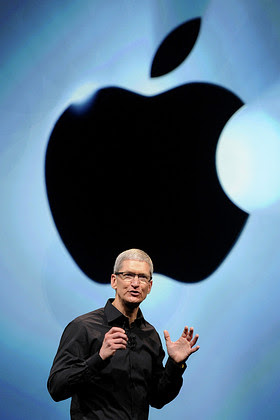
Apple CEO Tim Cook (image credit)
NBC News writer and editor Rosa Golijan posted this article on her Google+ profile:  Tim Cook teases 'exciting new product category' and 'more surprises' from Apple in the fall.  It was definitely a lot of teasing, which, depending on your view of that proverbial glass, was either a half-tempting or a half-feeble effort. 
CEO Tim Cook teased... "Our teams are hard at work on some amazing new hardware, software, and services that we can't wait to introduce in the fall and into 2014. We continue to be very confident in our future product plans..." There will be "really great stuff coming in the fall and across all of 2014." 
When asked about the new product categories, Cook declined to provide a specific timeframe, suggesting a new category may not appear this year. "The reality is that the work we do to produce truly innovative products is very hard...  I assure you that we're working very closely with manufacturing partners to achieve a very exciting roadmap."
I added this to the conversation, in reference to the Market Watch article:  Apple earnings drop; dividend, buyback raised.

Hmm, let's see. Apple stock has been on a steady decline since its 52-week high in September 2012 (705.07) and is just off its 52-week low (385.10) at 406.13 right now. Sentiments suggest that they're playing at .500 ball (in the middle between bearish and bullish), which is positively mediocre. So Cook's teaser, six months before they introduce their new stuff, may be more for investor confidence than for customer excitement.

That was in April, and now we can see that that teasing worked reasonably well for Apple.  At least Cook steadied the decline in investor confidence, which began nearly a year ago, with the stock closing yesterday at 409.22.

(image credit)
Cook strikes me as an intelligent and capable top executive, who must have a realistic bearing on what he can and cannot do, especially in the long shadow cast by Steve Jobs.  His new innovation strategy may not knock our socks off, but it sounds really good.  Jobs made the complicated innovation process seem easy, sleek and flawless, not to mention sweatless.  Cook and other CEOs know otherwise.

Proliferate the portfolio

Whether it's the iPhone or Facebook, The Next Big Thing is simply not an everyday occurrence that can be ordered, as if it were a menu item.  Instead, writer Hadyn Shaughnessy with Forbes described it brilliantly as proliferating the innovation portfolio.

Not one, not two, not three innovations, but more.    

Produce the next small things

I remember a gift that friends gave me.  It was a picture of a rock climber, looking like an insect against a massive wall of a mountain.  The saying was, Yard by yard, life is hard.  Inch by inch, life is a cinch.  I've since rephrased it as Think big, act small, step-by-step.

In a similar vein and in lieu of a category buster, the innovation Zeitgeist among the big boys in technology is to produce a set of The Next Small Things.

Embed innovation widely

While Jobs may have conceived of innovation as a sort of oligarchy in the organization, that is, the purview of a chosen few who assume responsibility and control of it, Cook has apparently embedded it more widely and deeply in the DNA of Apple.

I wonder, then, how well frontline staffers are encouraged to innovate and whether they have fewer barriers to cross, if they want to run an idea by management.

Innovate everyday

For me, these are impressive efforts at innovating on innovation.  Innovation is not the exclusive right of The Gifted or The Visionary.  But to the extent that we, including CEOs, view it essentially as a mindset, and not as a process, platform or product, then we truly rip that proverbial box apart and we stand in front of an open vista for innovating.

Shaughnessy closed with:
The name of the game right now, and we see it in Apple, Google, [and] Amazon[,] is to innovate in multiple ways all the time, to do “innovation every day”. That takes enormous resources and confidence. Apple has it in abundance, and conditions are looking ripe for it to move from the lab to the market. Just like Google six months ago, Apple looks ready to roll.
Thank you for reading, and let me know what you think!

Ron Villejo, PhD
Monday, June 17, 2013

E is for e-xperience


Many of us have transitioned our reading from  hardcopy to ebooks, and many more will do so over time.  eBook sales are expected to increase further this year, and should surpass print and audio-books by 2017.

I began this process many years ago, when I was a management consultant working for an international firm.  My travels took me anywhere from two to six countries in one trip, and the amount of client material I had to haul was back-breaking.  So I schooled myself to read manuals electronically, which were typically in large binders.  I cajoled myself to take interview notes directly onto my laptop.  Instead of packing pamphlets, brochures and newsletters, I relied on client websites for such information.  By now, I hardly ever read anything hardcopy, and I rarely use a pen or pencil anymore.  Meeting notes, article ideas, personal notions go right to the Notes app on my iPhone, and it's very convenient to review them on-the-go.

That said, I encourage adults and children alike to read more via The ReadBook.  Regardless of their language, culture or country, they ought to read for the pleasure of it and for the ways it expands and enriches the mind.  "E is for e-xperience" is one of my latest ReadBook videos, where I focus on the phenomenology of reading in the digital age, and its impact:  from publishing and literature, to science and science-fiction.

I ask, What should we call that e-xperience?  My idea was to look at this creatively, maybe with an eye for irony (e.g., using moveable type for an ebook).

I gathered the images I used in the video, and offer the following context and contrast.

New era of publishing

The new Gutenberg Moveable Type

(image credit)
Johannes Gutenberg invented the moveable type, and revolutionized printing in the 15th century (image credit)

Day of the Illustrator

(image credit)
Lithography, along with engraving and etching, were once the mainstays of illustration (image credit)

The Concerto Accompaniment

(image credit)
We can draw on our imagination, but otherwise books are without soundtrack (image credit)

Digital era of science

The Metaphor of Fluid Mechanics

(image credit)
Fluid Mechanics is a metaphor for what may be a difficult-to-grasp, watery experience (image credit)

The new Skin Literacy

(image credit)
Automation, algorithms and digital may supplant the tried-and-true ways of reading the skin (image credit) 

Theory of Digital Relativity

(image credit)
Albert Einstein may have gladly read ebooks and worked on digital theory (image credit)

Re-vision of literature

Rebecca's Library at Manderley

(image credit)
Manderley is the estate in du Maurier's romantic mystery Rebecca (image credit)

1001 Arabesque Nights

(image credit)
I sought that lyrical pun between Arabian and arabesque (image credit)

The e[mbedded]Book

(image credit)
In the future will books be programmed onto microchips and embedded in our skin? (image credit)

'Facting' of science-fiction

Bourne Subterfuge

(image credit)

Minority Reality

(image credit)

Matrix Uploaded

(image credit)

Altering the painting

The Alteration of Lesendes Mädchen

(image credit)
Lesendes Mädchen, painted by Franz Eybl in 1850 (image credit)

Tower of Tablets

(image credit)
The Tower of Babel, painted by Pieter Bruegel, The Elder in 1563 (image credit)

The Cyber Sistine Chapel

(image credit)
The Creation of Adam, painted by Michelangelo at the Sistine Chapel in 1509 (image credit)

The video


Thank you for reading, and let me know what you think!

Ron Villejo, PhD

Social Media, Marketers and ROI


If you're a marketer, here's a very informative article about what your colleagues in the business are thinking about and are interested in:  Research Shows Blogging a Top Focus for Marketers.  If you're a consultant, this article offers a good look at the state-of-mind among marketers.

(image credit)
Here's my comment on the Social Media Strategy community on Google+: 

A superb, very informative article, Jeremy. The key figures look very close, especially for the first two questions. So their differences may not be significant. The author highlighted blogging, for example, but another author could've just as persuasively highlighted Google+. For me, this article is less about the state-of-marketing, than state-of-mind among marketers. In this regard, it's clear that blogging, Google+, Facebook and LinkedIn are top-of-mind for these marketers. Anyway, there's a lot to speak to in this article. Thanks for posting!

Here are screenshots from the article, which I speak to:


A process for measuring ROI
When asked to rate their agreement with the following statement, “I am able to measure the return on investment for my social media activities,” only 26% of marketers agreed! What’s interesting about this survey is that social media is clearly a core strategy for businesses, yet measuring it remains a mystery.
It is a bad sign that marketers engage in such a core strategy as social media, but have little or no clue how to measure it.  So let's think this through.  First, they ought to review what they were trying to accomplish with social media, to begin with.  What were the issues or challenges they faced, and what benefits or outcomes they expected?  Optimally, it's best to 'begin with the end in mind,' then create the 'roadmap' for reaching that end.

But I suspect that marketers are already in mid-stream with their social media efforts and have begun to invest time, resources and cash into it.  This means having a retrospective on earlier conversations, decisions and activities.  Regardless of how they do it, they must be crystal clear on what they were trying to accomplish from the get-go.  Second, then, in the vein of critical, honest review, how well do their social media and other efforts work vis-a-vis their aim?  This review is the platform for determining and measuring ROI.  

Keep in mind that ROI means Return on Investment.  Too many managers, consultants and marketers focus on only one factor of the equation, that is, outcomes, benefits or results.  Rather, it is all of these good things calculated against the costs of actually making these good things happen.  When costs are in the service of getting something more in return, we call them the euphemism investment.

Moreover, some of us neglect to calculate the wide range of real costs, except for dollars spent.  How much time and resources did it take to make these good things happen?  What about opportunity loss associated with these efforts?  Salespeople in a training program not only incur registration and material fees, but also time away from the field means means zero sales.  What is the estimated lost business for the training session?      

So if a marketer were to ask me, How do you measure ROI of social media?  My first response is to ask, again, What are your objectives and goals for this platform?  Then, how well are your efforts going against these aims?  If the aim is to increase sales by 10%, for example, then how much is social media activity moving the needle toward this figure?  What were the total, real costs of your social media initiative?   

Measuring ROI of social media is still a complicated, challenging process, but by clarifying your aim and calculating results against costs properly, you make this process significantly clearer and more doable.  Above all, it ought not be a mystery.

Thank you for reading, and let me know what you think!

Ron Villejo, PhD

Sunday, May 19, 2013

A Follow-the-String Journey


Imagine walking around your neighborhood, and seeing a string carelessly but loosely draped on shrubery off to the side. You pick it up, and follow it to wherever.  By and large, it keeps you on the sidewalk.  But at times it draws you into others' yards, and on occasion a homeowner invites you to come in.  You're a neighbor, after all.  A pleasant, engaging conversation over coffee ensues in the living room.

Social media is a platform for discovering curious strings like that, and the internet in general is the means by which we can follow any string that catches our fancy.

Earlier this morning, I reviewed my Facebook notifications, and saw it was my turn to poke each of two friends back.  For several weeks now, we have kept this sidebar going.  I'm not into poking, but when someone pokes me, which is hardly ever, I poke back.  Poking is a casual, perfectly fine thing to do between friends, but between a man and a woman it slips into unmistakable flirtation and sexual innuendo.  So when Facebook suggests other friends for me to poke, I ignore it.

A Sunday Journey

1.

Instead of just closing the poke notification window, however, I went to visit a friend:  I found this video posted on her Timeline. It's an operatic accounting of the many things a Mom says to her children everyday. It's a really awesome, funny performance. I find out that the lady singing is Anita Harshey.


Facebook makes it really easy to share posts, so while the video was in a format and location I wasn't familiar with, I could post it directly to my Timeline.

2.

I recognize the music of "The Mom Song" as "William Tell Overture," composed by Gioachino Rossini and premiered in 1829. It's the rousing finale of his Overture that has bee popular in American culture for decades.


If you want to hear the full Overture, here it is.

3.

You see, I'm really impressed by the talent behind "The Mom Song" ... taking the music about a 15th-century Swiss legend (William Tell) by a 19th-century Italian composer (Gioachino Rossini); and turning it into an awesome modern-day opera that prompts a church audience to give it a standing ovation ... well, I just had to research it further. So meet Anita Renfroe who wrote, and first sang, "The Mom Song."


4.

I continued, drawing on an interview on iFlourish and a biography on Wikipedia:  I find out that Anita Renfroe is an American Christian comedian, mother and wife. Apparently her young children teased her for being the only comic without a YouTube channel, and called her lame. Not one to be dissuaded from an implicit challenge, she wrote down all the things a Mom said over a 24-hour stretch and condensed it all to a 3-minute video that she called "Momisms." She planned to delete the video on Mother's Day 2007, but her children convinced her to keep it. The video and the song went viral!

Anita Renfroe (image credit)
5.

I am impressed with others' talent not only in their profession or craft, but also in the marketing of their stuff:  Her children's dare, a comic's humor, and a Christian's faith all figure into a career that blossomed for Anita Renfroe. She's a correspondent for the popular "Good Morning, America"; has written five books, and become a grandmother.  Here's a more recent showcase of her talents!


6.

Never mind that first invitation to come in, I was now well-engaged in a second conversation-cum-coffee at a neighbor's house across the street:  There's more to this wholly unplanned journey that I find myself on. Curiosity is what drives my SUV, and I'm just sitting in the backseat, watching the half-familiar, half-unfamiliar terrain outside the windows. Vanessa Van Petten writes a song herself, as a kid's response to "The Mom Song." The following are her video response and the opening lyrics to her song:
I am up, I am up, Im up and dressed
Can I wear this, am I cute, are the boys impressed
Wheres my clothes and my shoes and my backpack at
And, Yes Im wearing that
No mom, no OJ, wheres the pop tarts at
Wheres my lunch, eww gross, do I look fat?
After school bring me a snack when I get back
And then its homework until I collapse

7.

I find that Vanessa Van Petten has her own website - Radical Parenting - dedicated to helping parents gain better insight into their children. Apparently she has 120 teen writers who contribute to her website. She herself is an active author, speaker and YouTuber, and I think her concept is awesome!


Vanessa Van Petten (image credit)
A Sunday Curiosity

Following the string is also for the sake of learning about successful efforts like those of Renfroe and Van Petten and then extracting the algorithms of their success.  Having talent is number one, of course.  Having marketing savvy, too, is crucial.  Finally, having patience and persistence are undoubtedly a necessity for the vast hordes of us, as we work at our stuff and engage others around it.  

There is more of course that I want to look into and learn about, but I believe I'm on the way with my projects and they're on the right track.

Thank you for reading, and let me know what you think!

Ron Villejo, PhD