Not hopeful about RIM
Let’s be clear about this. I love my BlackBerry for the reasons that many
others love it. Its QWERTY keyboard is perfect for me, as it’s familiar to my
laptop-fashioned mental schema. Also the surface of its keys fit my thumbs very
well, so I can tap a message quickly and accurately. I like the range of
messaging options available to me, from BB Messenger (BBM), to WhatsApp and
Google Talk, and of course to the commonplace SMS and e-mail. Oh, yeah, I
really like the LED, and I check my BB often for its blinking red light, as if
it were some kind of fix for an addict (lol)!
Still, I’m not hopeful about the BB, and as
Roger Cheng advises in his article, my next mobile device will be an iPad2 and either
an iPhone or an Android-operated smartphone. Why? Well, for reasons that have
to do more with Research in Motion (RIM), the BB maker, rather than the BB per
se.
You see, I bought my (first and only) BB in July 2010. Friends had been
asking for my BB PIN, and I was embarrassed not to have one. But in less than a
month, there was an uproar about the United Arab Emirates, where I live,
threatening to block BBM services. Saudi Arabia and India made similar threats
to RIM, unless it allowed these countries access to its BBM data. They cited
security concerns. This issue was intriguing in and of itself, but that’s
another story. What I learned about RIM, with just a bit of research, was how
UN-innovative it was and how late-to-the-party it was. The Torch was coming out
about that time, and RIM was touting its touch screen and sliding keyboard.
Whoop-de-doo (haha) ;P Been there, done that. It was so
first-decade-of-the-21st-century.
Reports were that about 500,000 BBM users were in the UAE at that time. So I
expressly reassured my friends that the UAE was unlikely to actually block BBM.
But I also posted on Facebook that BB was on the royal road to extinction. What
Apple does, what Google does … well, that excites me, both as a consumer and as
a businessman.
I love my BB, as I said, but my love for it has waned steadily over the past
year. I gathered that RIM was in a panic mode about how to regain its market
share. Well, that’s understandable, but panic in the high stakes business of
mobile devices is not exactly a confidence-booster in the marketplace, is it.
Unfortunate negative association
Rioting must be as old as humankind itself, and it’s no less tragic when it
happens now. It inflames emotion, to say the least. One friend on
Facebook, for example, described the rioters in the UK as a “bunch of pathetic
wastes of space.” Another friend is sick and tired of hearing all the
feeble excuses for their rioting.
A Bloomberg article noted that many of the rioters organized themselves
on the BlackBerry Messenger. As one marketing director suggested, the
association between this unrest and BB was another negative hit for an already
panicked Research in Motion, the maker of BB. You see, RIM is rapidly
losing market share to Apple and other mobile makers using the Android
operating system.
Well, it’s a bit of irony for RIM, isn’t it, that so many of these young
people in the UK seem to have taken up the BB. Good for its market share,
no?
The most unfortunate irony for me, however, is this negative
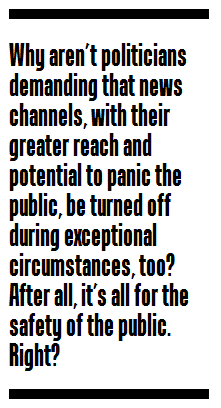
association. For a UK Parlaiment member to call for a ban on BBM services
is as illogical, indeed, as to blame the long-trusted (stationary) phone or
the venerable handwritten letter as the cause of negative events communicated
through its medium. If BBM could speak, it would harken back to that old
saw, “Don’t kill me! I’m only the messenger.” It’s frankly nutty.
So it is. Such association is clearly part of human nature. It’s
irresponsible, too, that Bloomberg would (initially) title this article so
provocatively that it reinforces this sort of blaming: “BlackBerry Falls
from Executive Suite to UK Mobs.” Alas, the editors of Bloomberg are part
of that human nature.
I have noted before that under heightened emotion, in high stress
situations, people can lose their sense of perspective, judgment, and
logic. Put more bluntly, the smartest among us can come across as
downright dumb, if subjected to sufficient degrees of pressure. Understandably,
the thinking mechanisms in our brain have their limits. So, just as with
any piece of machinery, these mechanisms can break down, if operated beyond its
predesigned uses.
What to do, then?
All parties involved in this rioting need to find a way, of course, to calm
down and regain self-control. So better judgment can prevail once
again. RIM itself must grasp human nature in all of its glorious (and
IN-glorious) manifestations, especially how it gets played out in groups (i.e.,
mobs). As Apple and Google understand rather superbly, their success is
based not just on how innovative their technology is, but also on how well they
grasp human thinking, emotion and behavior. How well the executives at
RIM understand these, I don’t know.
It is laudable indeed that RIM, as a “good corporate citizen,” will work
with authorities to help in any way that it can. But this is not
enough! The company must give a firm, clear message that it does not
condone the violence in the UK and that, at the same time, people ought not
kill the messenger. BB is not to blame for the rioting! But as of
right now, there is no such message on the RIM website.
Amidst this awful rioting, RIM has an opportunity to strengthen its
position, and to do so in a sensitive but strong manner. Is it
late-to-act again?
Thank you for reading, and let me know what you think!
Ron Villejo, PhD




+2.PNG)


